Hairdressers and barbers · Jamaica
How to Get More Hair and Barber Clients in Jamaica
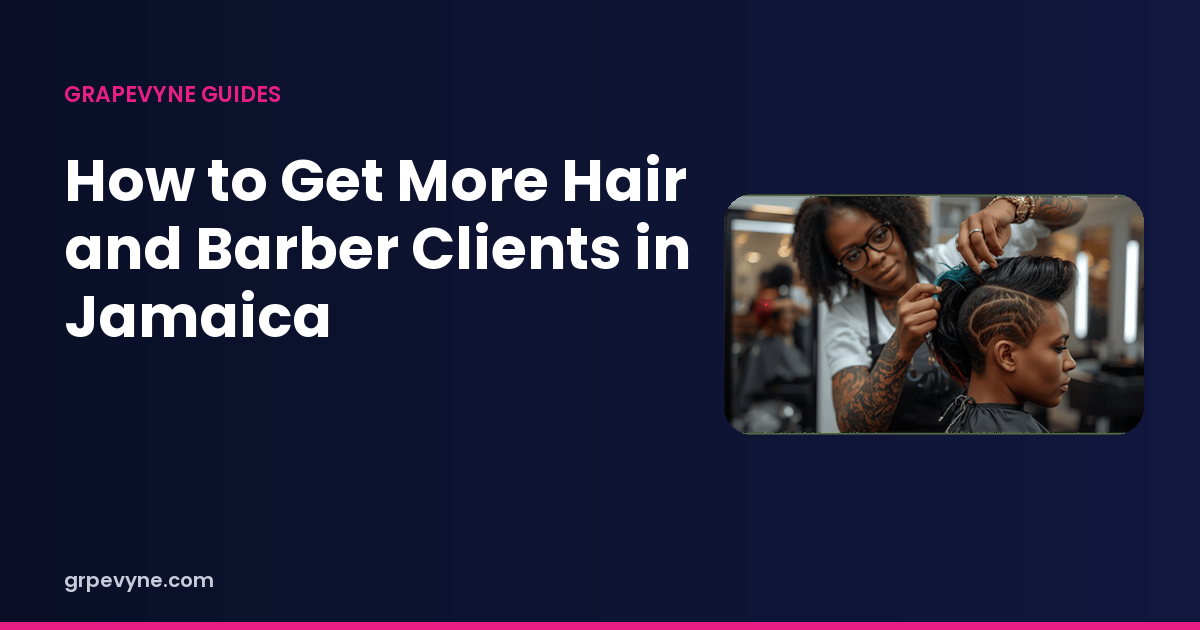
If you cut or style hair in Jamaica, the work is rarely the part that falls apart. The gap is what happens after someone likes a photo, or hears that your fades are clean, or sees a braid style on a friend’s status. They screenshot it, send it on, and message you two days later while you are mid-cut with your phone in a drawer. By the time you reply, they have already sat in the chair that answered.
Getting more clients is mostly about being easy to trust and easy to book. The same habits work if you rent a chair in New Kingston, cut from a room in Portmore, braid around Montego Bay, or take appointments after a day job in Spanish Town. A barbershop with a Saturday queue and a hairdresser who works by appointment are different rooms. The missing piece is usually the same: a stranger cannot tell what you do, or when they can have you.
Give people a place to check before they message you
A lot of hair clients still find someone through a cousin, a WhatsApp status, or an Instagram story. That part is not going away. What they do next is look for proof: your name, recent work, what you actually offer, and whether you are taking people this week.
If all of that lives in a highlight and a “DM for prices” line, you are asking them to start a conversation just to learn the basics. Some will. Plenty will message the next person instead, especially if they are comparing two or three stylists on a lunch break, or trying to get a cut before Friday night.
What a stranger should be able to see
- Your name, and the area you really serve. “Half Way Tree, and I travel inside Kingston with notice” is more useful than “islandwide” if islandwide is not true. A shop address and a note about parking or which gate to use saves a message.
- The services you do, named the way clients ask. For a barber that might be a cut, a shape-up, a beard, a kids’ cut. For a hairdresser it might be a wash and blowout, silk press, knotless braids, locs retwist, color, or a trim. If you do not do a service, leave it off. That saves both of you a message, and it stops a relaxer request landing on a barber who does not do chemicals.
- How booking works. Appointment only, walk-in, or home visits. If the shop takes walk-ins until the chairs are full, say that. If traffic means you need a gap between home visits, say so.
- One link that stays put when you change phones. Bios get edited. Statuses expire. A single page you can drop in Instagram, WhatsApp, and anywhere else keeps the details together.
Grapevyne is one way to build that page. You get a public profile and a booking link, in the shape of grpevyne.com/book/your-name, that lists your services and the times you have marked open. People browsing nearby can also find that profile. It does not create clients out of nothing. It gives the people who already like your work a front door.
Photograph the work so it can speak for you
Hair clients buy what they can see. A blurry mirror selfie in a dark shop makes a clean fade look uncertain, and it hides whether the braids are neat at the hairline. You do not need a studio light. You need the same few habits every time.
- Use daylight from a window or the shop’s brightest corner. Overhead bulbs flatten color and hide a lineup.
- Show the finished style from the angle that explains it. A fade needs the side and the back. Braids and locs need the hairline and the length. A silk press needs the ends, not only the face.
- Keep the background quiet enough that the hair is the subject. A cape and a plain wall are enough.
- Ask before you post. Hair photos usually include a face. Some clients are happy to be your portfolio. Some are not, and that decision is theirs. A photo of the back of the head is still useful when they say no to the front.
Keep recent work at the front. A carnival style from last year is a weak way to introduce yourself in October. When a cut or a braid set does well, you do not have to bury it under a caption full of tags. One clear photo and the name of the service is easier to understand.
On Grapevyne, paid plans include a work showcase so those photos can sit on the same profile as your services and booking link. Instagram can stay the place you talk to people. The profile is where the photos stay next to a time they can take. What each plan includes is on the pricing page.
Use Instagram and WhatsApp without living in them
Instagram is where a lot of Jamaican hair work gets discovered. WhatsApp is where the booking usually tries to happen. Both are useful. Neither one is a calendar.
A steady rhythm beats posting ten times and then going quiet for a month.
- Show finished work a few times a week when you have it. A story is enough on a quiet day. A barber can post the Saturday cuts on Sunday. A braider can post when a long style is actually done, not halfway through with a promise.
- Put the booking link in your bio, and on the story, when you post a style people are already asking about.
- Answer the price question in the caption or on your page when the price is fixed. A standard cut has a number. “DM for prices” feels exclusive. Most of the time it is just another step. If braids or color change with length and density, say what changes the price instead of hiding the whole menu.
- Use WhatsApp status for people who already know you. “Thursday afternoon is open” or “Friday after 5 is full” does more for your regulars than another generic post.
You will still get messages. That is the relationship. The win is when the message says “I booked Thursday” or “Can you fit a shape-up at 2?” instead of a full negotiation that starts from zero every time. If the inbox is the part that is breaking, taking appointments online is the next piece to fix.
Shorten the path from “I like this” to a time
The client who wants you has already made the hard decision. The easy part should stay easy.
The path that loses people looks like this. They ask if you are free. You reply the next day. They ask the price. You send a voice note. They ask what time. You say you will check. While they sit in traffic on Mandela Highway, they message someone else, or they walk into the shop that does not need a thread.
The shorter path is: they see the service, the price if you are willing to publish it, and an open time. They take it. You both have a record of what was agreed.
If you are not ready to publish prices, still publish the menu and how long each service takes. A six-hour braid appointment should not be booked like a twenty-minute lineup. A color needs processing time that a trim does not. When the length is visible, people stop guessing, and you stop inheriting their guess.
Speed is not the same as being glued to your phone during a service. Check messages between clients. If you cannot answer properly, one line is enough: “I’m with a client. Open times are on my page.” If you are booked out, say so. “I’m full until Tuesday” is kinder than silence, and it gives them a reason to wait for you instead of sitting with whoever is free.
Let reviews carry some of the trust
A stranger believes another client more easily than they believe a caption. After a cut or a style you are proud of, ask in plain language. “If you liked it, a short review helps the next person decide.”
On Grapevyne, a client can leave a review after a completed booking, and it shows on your profile. That only happens if the appointment lived on the booking, not only in a chat. A review that names the service is more useful than five stars and a blank line. “Clean low fade, on time” tells a new client more than a heart emoji. You cannot write those for them. You can ask while they are still looking in the mirror.
Keep the clients you already have
New followers are flattering. Repeat clients are the business. A barber who sees the same ten people every two weeks is often earning more than a stylist chasing a new braid client every day and losing the last one.
- Remember what they like. The fade number, the side they part, the fact that they want the beard lined and not shaved down, the color formula, the fact that they run ten minutes late so the next slot needs a little air.
- Offer the next appointment before they leave. People who wear a cut already know they are coming back in a few weeks. People with braids or color already know there is a takedown or a retouch. Give them the date while they are still in the chair.
- A reminder the day before catches the person who meant to come and lost the day. Grapevyne sends booking reminders by email and push to you and the client, including one about a day before and another about an hour before the start. A reminder is a nudge. It is not a promise they will walk in. There is a fuller note on that in how to reduce no-shows.
- When someone sends a friend, thank them. Remembering the name of the person who referred them matters more than a complicated loyalty card. In a shop, that introduction is often the whole growth plan.
Keeping the book in one place is what makes “your usual Thursday” possible when graduations, weddings, Christmas, or carnival week get loud.
A week of small fixes
- Pick one link for your bio and your WhatsApp status.
- Put your real services on it, with how long each one takes. Separate the short work from the long work.
- Mark the times you can actually work, including the evenings that belong to church, school pickup, or another job.
- Photograph the next three clients in the same light, and only post the ones who said yes.
- Ask one happy client for a review, and offer your regulars their next date before they leave.
If you are still deciding whether this is a business or a side practice, starting a hair or barber business in Jamaica covers services, pricing, and the first clients. If you want the link itself to be a booking page, the hairdresser and barber page shows how Grapevyne handles the profile, the services, and the calendar.